Enquiries: 0800 3167566 | Support: 020 8545 8545

THOUGHT LEADERSHIP GUIDE
TRANSFORMING CX FOR TRAVEL AND HOSPITALITY
ASK AI – WHY OPUS?



Why CX in Travel and Hospitality needs a new approach
If you work in travel or hospitality you already know how much is riding on every interaction. A booking enquiry, a change request, a delayed journey, a loyalty question, a guest complaint – each one is a chance to build trust with your customers or to lose it.
The challenge is that customer expectations have changed faster than many service operations. Your customers want fast answers, joined-up conversations, and the freedom to move between digital channels and human support seamlessly. At the same time, you are under pressure to control costs, support your teams, and make better use of the systems you already have.
That is why the contact centre matters more than ever. It is no longer just there to answer calls; it shapes bookings, loyalty, service recovery, and perceptions about how easy it feels to do business with your brand.
When customer contact is connected, flexible, and intelligent, it can do far more than absorb demand. It can help you improve loyalty, protect revenue, reduce pressure on agents, and deliver a more consistent experience from booking to resolution.

5 challenges reshaping travel and hospitality service
1. Delivering hyper-personalised experiences
Customers expect you to recognise who they are, understand their history, and pick up where the last interaction left off. That is hard to do when booking data, loyalty information, service history, and payments all live in different places.
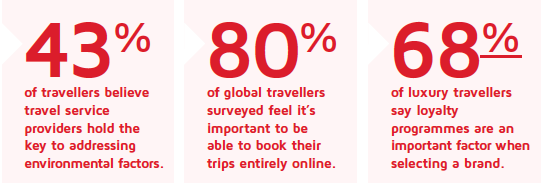
Customers also expect their preferences to be remembered and to be provided with recommendations aligned to their interests. Being able to tailor interactions in real-time, using customer information, can be a game-changer, and with many customers choosing to book online or via apps, travel and hospitality businesses need to replicate traditional agent-led booking digitally.
2. Customers want self-service, but not at the cost of a poor experience
Personalisation is now a core part of what travel and hospitality customers For many customers, the experience begins well before the stay, visit or journey itself, with greater control over bookings, plans and itineraries becoming an important part of that experience.
Customers want fast, easy self-service for simple tasks such as checking details, updating bookings, and getting quick answers. But when self-service feels clunky or limited, it creates frustration. They want the convenience of digital tools, with the confidence that human support is easy to reach, when a need is more complex or urgent.
3. Strengthening loyalty in a competitive market
Rewarding loyalty is still a massive driver for customers. Being recognised and rewarded accordingly is still an influencing factor when deciding brand preference. However, customers don’t just want off-the-shelf benefits, they want to be recognised as individuals, with access to special incentives that are personalised to them specifically.
4. Responding to sustainability expectations
Today’s traveller is now more ecologically conscious. Purchasing decisions aren’t just based on location, cost or star rating, but also on local sourcing and provenance to shorten supply chains and lessen transportation. Being able to demonstrate sustainable and eco-aware initiatives could attract a new cohort of customers.
5. Seasonal peaks and disruption put your teams under pressure fast
Demand in travel and hospitality On-sale periods, seasonal spikes, cancellations, service disruption, weather events, and last-minute changes can all drive sudden increases in contact volumes.
Legacy systems can struggle to scale efficiently, leading to longer wait times, inconsistent service, agent strain, and lost revenue. Cloud contact centres enable dynamic scaling and real-time workforce optimisation to maintain performance and guest satisfaction.

How to improve CX without making operations harder
Improving customer experience doesn’t have to mean making operations more complicated. In many cases, it means making customer contact simpler to manage, better connected and easier for teams to deliver consistently.
That starts with connecting the systems your teams rely on every day from CRM and telephony to booking engines, reservation systems, loyalty platforms, and business applications. When those systems work together, agents spend less time searching for context and more time resolving issues well. It also means automating the right things. Not to remove the human element, but to reduce repetitive demand, speed up routine journeys, and make it easier for customers to get simple things done without waiting. Done well, that gives you the best of both worlds: customers get faster, smoother service, while your teams have more time and more context for the interactions where empathy, judgement, and commercial awareness matter most.
Make personal service easier to deliver
Personal service should not depend on agent memory or workarounds. It should come from having the right data available at the right moment. When customer preferences, booking history, loyalty status, and recent interactions are visible in one place, your teams can respond in a way that feels informed and joined up without asking customers to repeat themselves.
Use self-service to remove routine pressure
There is no reason for your teams to be tied up with every simple request. Booking updates, reservation changes, balance checks, reminders, confirmations, and status enquiries can all be handled more efficiently through well-designed self-service and AI. That reduces avoidable demand and shortens queues, while still giving customers a clear route to a person when needed.
Turn service into a loyalty and revenue driver
Every service interaction has commercial value. A well-handled conversation can protect a booking, encourage repeat business, reduce churn, or create an upsell opportunity that feels natural rather than forced. That only happens when the experience feels timely, relevant, and easy. Better service is not separate from growth, it is often part of it.
Respond to growing demand for more sustainable travel
Sustainability matters more to today’s travellers. Businesses need to be transparent about how they operate and find practical ways to make processes and supply chains more efficient. Modern, cloud-based systems can support that by reducing energy use and making it easier to track and manage CO2 emissions across the supply chain.
Why legacy contact centre technology is starting to hold you back
At some point, ageing platforms stop being just an IT problem. They start affecting service quality, speed of change, and how much pressure your teams are under day to day.
When systems are hard to integrate, hard to scale, and hard to update, it becomes much more difficult to deliver the kind of service customers now expect. Customer journeys feel disconnected, automation is harder to introduce, reporting is incomplete, and even simple changes take more effort than they should.
That matters more now because customer expectations are higher than ever. Customers expect fast resolution, more personalised service, and a smooth experience across every channel. Legacy platforms make that harder to deliver consistently.

Why are leading brands moving their contact centres to the cloud?
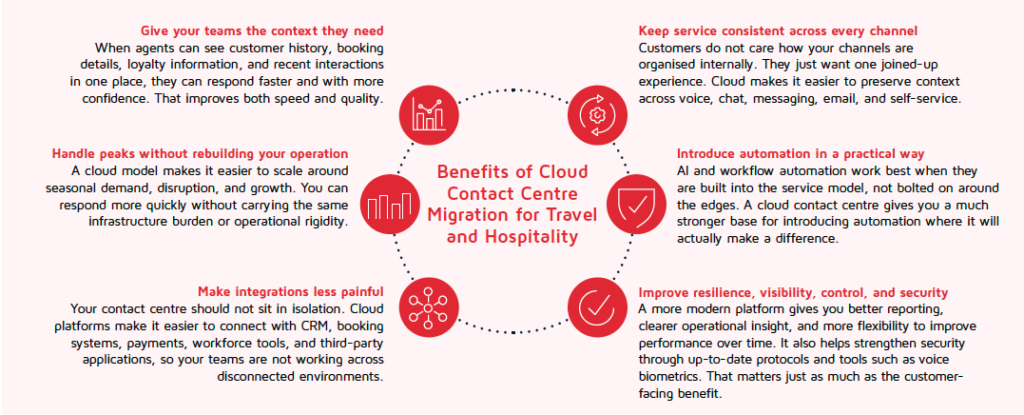
Moving to a cloud-based contact centre gives brands more flexibility and a stronger foundation for improvement. It becomes easier to connect booking engines, reservation systems, loyalty programmes, payment platforms, CRM, and telephony, so teams have better context and customers get a more joined-up experience.
It also makes it easier to introduce the tools that are increasingly shaping modern service. That includes agent assist, to help advisors respond faster and more accurately, AI agents to handle routine requests at scale, and advanced analytics to give leaders better visibility into demand, performance, and customer behaviour.
With the right cloud foundation, automation can go further too. Workflows can act on customer data in real time, helping teams rebook cancelled trips, confirm reservations, process changes, or trigger updates across systems without unnecessary manual effort. That reduces workload, speeds up resolution, and helps maintain service quality during busy periods.
Cloud-based technology also makes it easier to deliver more personalised service. With better access to customer data, and Agentic AI able to interpret preferences, history, and intent in real time, brands can provide more relevant support, recommendations, and offers at each stage of the customer journey. That helps turn good service into stronger loyalty, higher spend, and more repeat business. And, as sustainability becomes more important in buying decisions, modern platforms also make it easier to track, report, and substantiate progress across operations and the wider supply chain.
How to create a more connected omnichannel experience
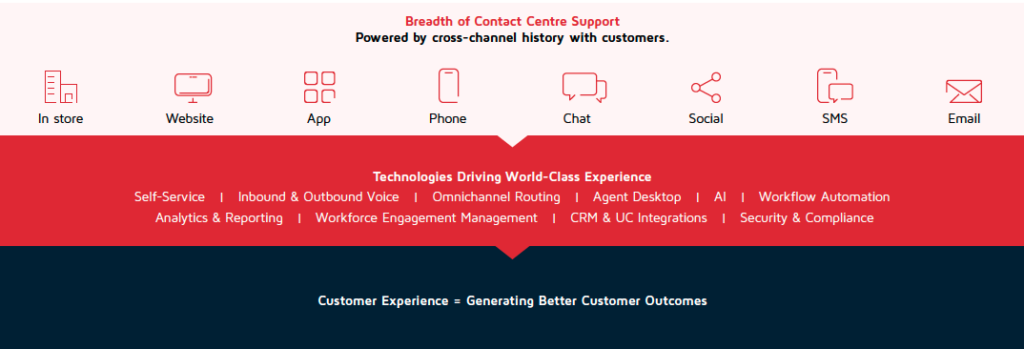
One of the quickest ways to damage the experience is to make customers restart their request again every time they switch channels. If someone begins their conversation on live chat, follows up by email, and then calls because the issue is urgent, they should not have to repeat who they are, what has happened, and what they need from scratch. Yet that is still the reality in many service environments. A true omnichannel contact centre keeps the conversation connected.
It carries context from one interaction to the next, so customers can move between channels more naturally and agents can pick things up without losing momentum. That reduces frustration for customers, and it also makes life easier for your teams. Less repetition means shorter handling times, smoother handoffs, and fewer interactions shaped by avoidable friction. Omnichannel is not really about offering more channels. It is about making them work together.
Where AI can make the biggest difference to CX
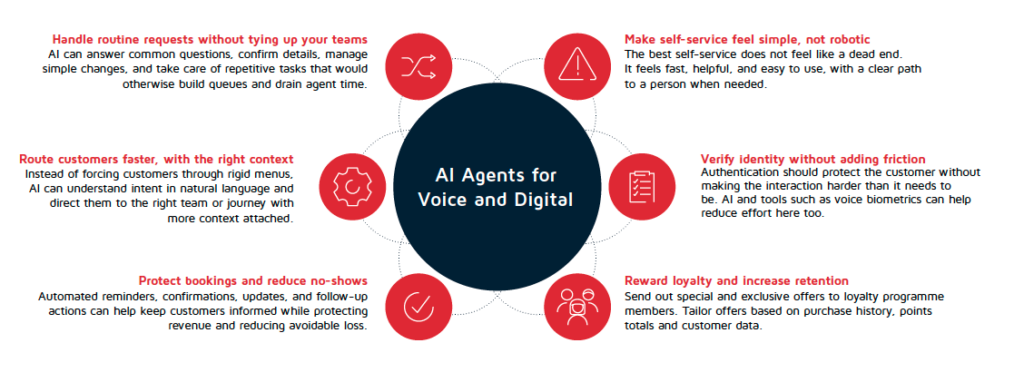
The most useful role for AI is not replacing people, it is when AI agents and human agents work hand in hand to deliver hyper-personalised and effortless customer experiences. That means using AI to handle routine questions, support faster routing, surface relevant context, and help customers complete simple tasks without having to wait for an agent. It also means giving your teams better information during live interactions, so they can focus on the part of the conversation that needs judgement, reassurance, or empathy. In travel and hospitality, the most valuable AI use cases tend to be practical.
Self-service to improve CX without losing the human touch
The best self-service gives customers a faster way to complete simple tasks while freeing your teams to focus on higher-value conversations.
In travel and hospitality that includes booking updates, reservation changes, confirmations, account queries, payment tasks, identity checks, and common service requests. These interactions matter, but they do not always need to be handled manually.
What matters is how self-service fits into the wider experience. It should feel natural, solve issues cleanly where possible, and pass customers to a human agent with context when needed.
That is where AI agents can add real value. Across voice and digital channels, they can answer questions, complete routine actions, and route customers in a more conversational and personalised way. With the right platform, brands can build and manage these journeys more easily, scale them faster, and adapt over time.
Done properly, self-service does not make service feel less personal. It gives your teams more time to focus on the moments where human support matters most to customers.
Transforming CX in Travel and Hospitality: Download the full guide
Discover how travel and hospitality brands can increase bookings, strengthen loyalty, and deliver more connected customer service across voice, digital, and self-service channels.
Download the Transforming CX for Travel and Hospitality guide to explore:
- How to improve CX without increasing operational complexity
- Why leading brands are moving their contact centres to the cloud
- Where AI automation and self-service can make the greatest impact
- How Saga reduced cost per contact by 22% and The Ivy increased conversion by 20%
Whether you are modernising your contact centre, preparing for seasonal demand, or exploring AI, the guide provides practical ways to reduce customer effort and give your teams more time for high-value interactions.
Get in touch to speak to our consultants about building more connected, scalable customer experience.